Publications
2026
-
TTutorTrace: A Dataset and Taxonomy for Classifying Learner Behavioral States during AI-Assisted Programming Education
Proceedings of the 39th Annual ACM Symposium on User Interface Software and Technology (UIST '26), Detroit, MI, USA, 2026
David Barron, Xiaohang Tang, Rezky Dwisantika, Minsun Kim, David H. Smith IV, Jiaming Cui, Yan Chen
AI programming tutors provide scalable support, yet lack the behavioral context human tutors rely on to adapt support to learners’ needs. We present TutorTrace, a dataset and behavioral abstraction pipeline that makes learners’ behavioral context visible and computable in real time from low-level IDE telemetry. Across four deployments in two introductory Python courses (N=480), TutorTrace captures approximately 180K telemetry events, 13,633 behavioral segments, and 27 continuously computed metrics. From this foundation, we derive a taxonomy of learner activity before the first AI query, between consecutive queries, and across the full session, enabling systems to respond not just to what learners say, but to what they have done leading up to the help-seeking moment. In a preliminary classroom evaluation, behavior-aware prompts were associated with a decrease in intervals between queries with no independent work from 50.0% to 20.7%. As an additional demonstration of downstream utility, we evaluate TutorTrace on two held-out prediction tasks: whether a learner will query within the next 60 seconds (AUROC=.726) and whether an upcoming query reflects guided or dependent help-seeking (AUROC=.717). Together, these findings show how behavioral context can enable adaptive AI tutoring at scale.
-
EExploring the Design Space of LLM-Based Programming Support in CS Education: A Scoping Review through the Lens of Assistance Governance
VL/HCC 2026
Minsun Kim, S. Moonwara A. Monisha, Zihan Wu, David H. Smith IV
As large language models (LLMs) become integrated into programming education, learner-facing systems increasingly differ in how that assistance is bounded, enacted, and controlled. These governance decisions are often described implicitly, making it difficult to compare systems in educationally meaningful ways. To address this gap, we conduct a scoping review and qualitative synthesis of 90 peer-reviewed LLM-based programming support systems in CS education. We analyze assistance governance through three dimensions, which we refer to collectively as PEA: Policy, capturing what forms of help are allowed or restricted; Enforcement, capturing how those boundaries are operationalized through interaction and system behavior; and Authority, capturing who can configure, adapt, or override them during use. Our findings show that systems often share similar pedagogical goals, but implement those goals through varied enforcement mechanisms. At the same time, authority remains highly centralized in system logic, with fewer systems giving learners or instructors runtime control. This work contributes PEA as a three-dimensional analytic lens, a governance codebook empirically refined within these dimensions, and a map of underexplored configurations in the current design space of LLM-based programming support. By making these explicit and comparable, PEA offers a vocabulary for analyzing existing systems and designing future tools that are pedagogically bounded, configurable, and accountable.
-
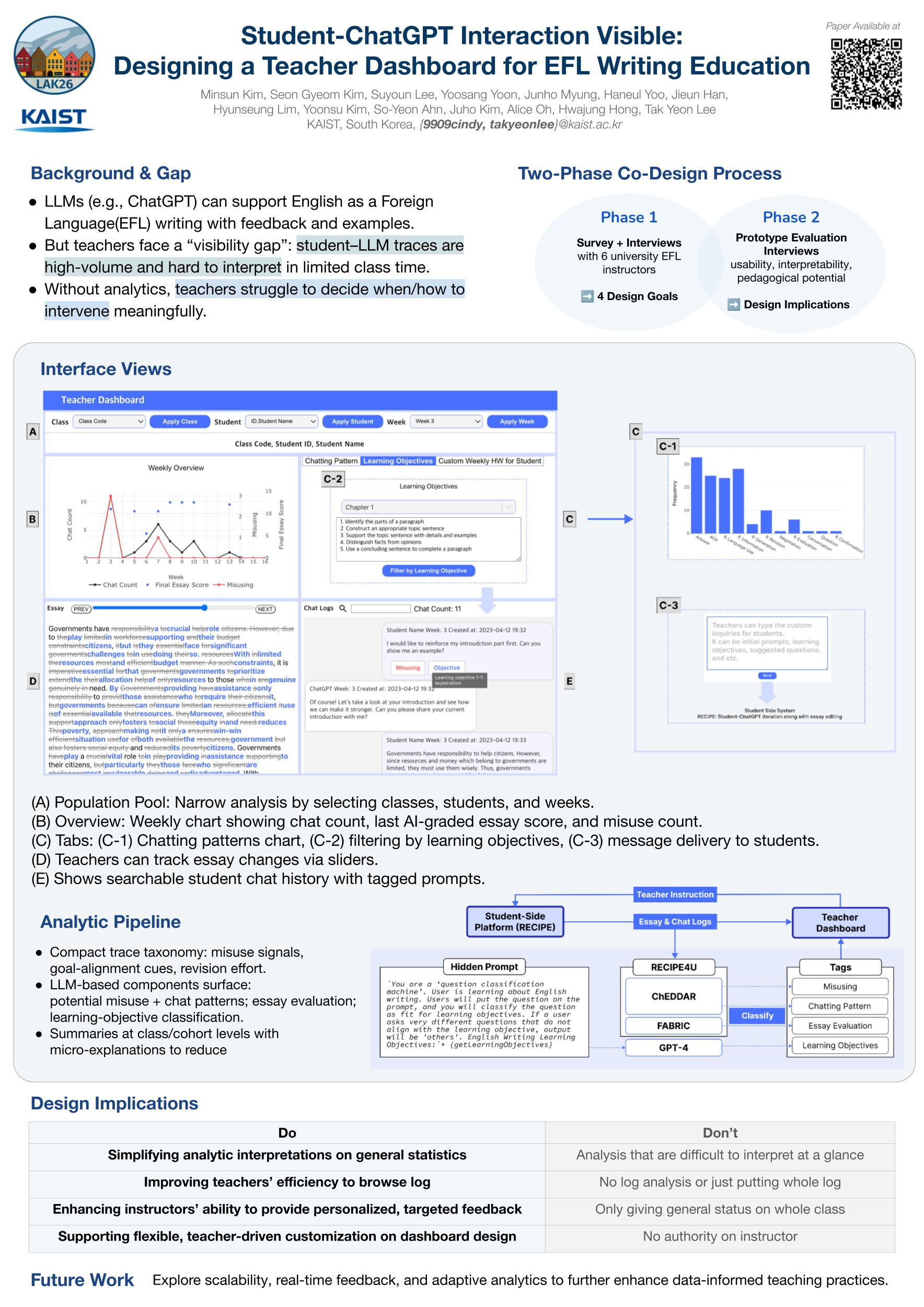 Student–ChatGPT Interaction Visible: Designing a Teacher Dashboard for EFL Writing Education
In Companion Proceedings of the 16th Learning Analytics & Knowledge Conference (LAK 2026)
Minsun Kim, Suyoun Lee, Yoosang Yoon, Junho Myung, Haneul Yoo, Hyungseung Lim, Jieun Han, Yoonsu Kim, So-Yeon Ahn, Juho Kim, Alice Oh, Hwajung Hong, Tak Yeon Lee
Conducted survey, interviews, and observation with six EFL instructors about ChatGPT-student interaction Developed dashboard prototypes with React, Plotly, and OpenAI API Investigated design implications of prompt monitoring dashboard through thematic analysis
2024
-
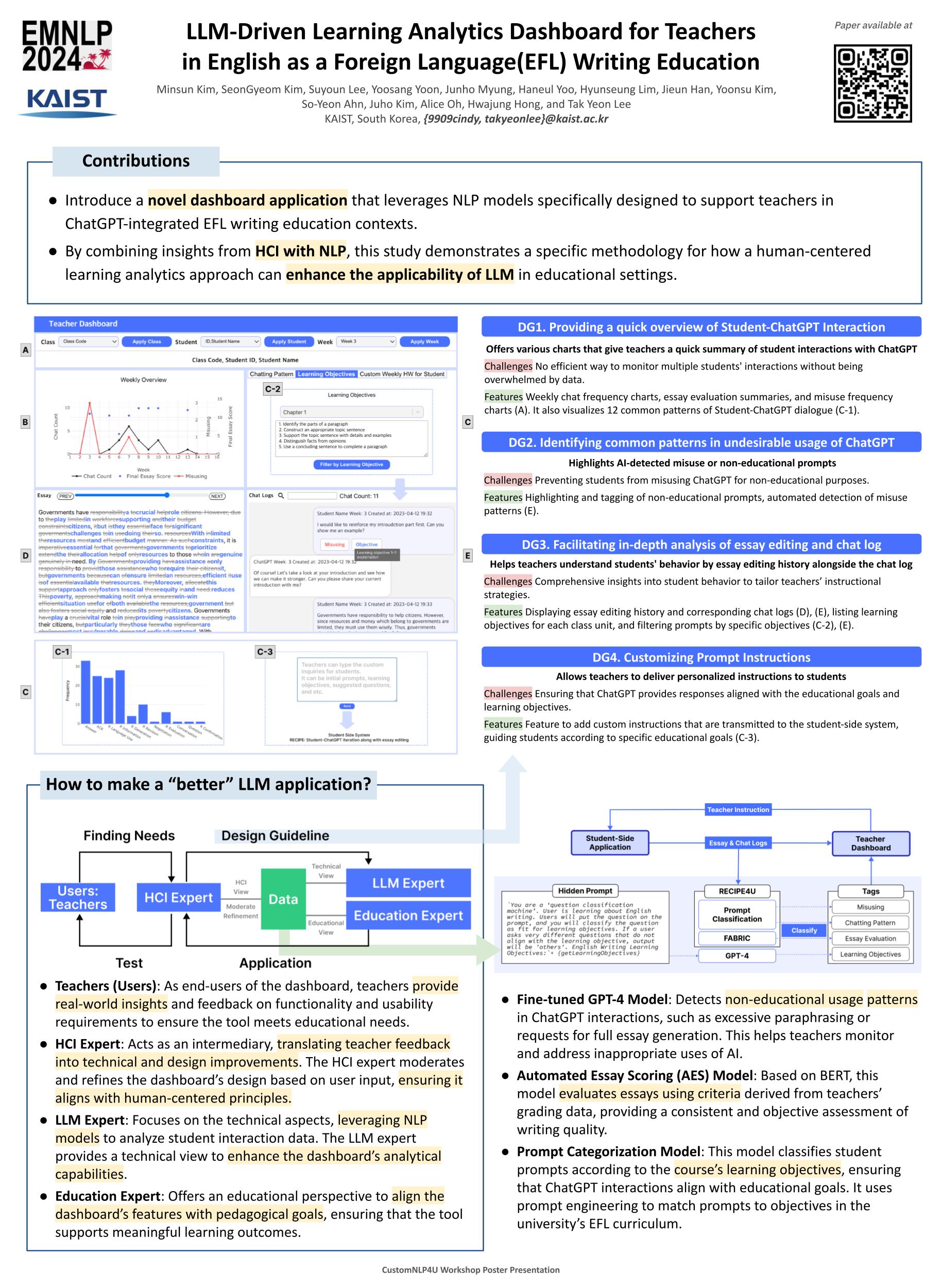 LLM-Driven Learning Analytics Dashboard for Teachers in EFL Writing Education
EMNLP 2024 Workshop on Customizing NLP for All (CustomNLP4U)
Minsun Kim, SeonGyeom Kim, Suyoun Lee, Yoosang Yoon, Junho Myung, Haneul Yoo, Hyungseung Lim, Jieun Han, Yoonsu Kim, So-Yeon Ahn, Juho Kim, Alice Oh, Hwajung Hong, Tak Yeon Lee
Introduces a learning analytics dashboard that helps EFL teachers monitor student ChatGPT interactions and align classroom strategies using LLM-driven insights.
-
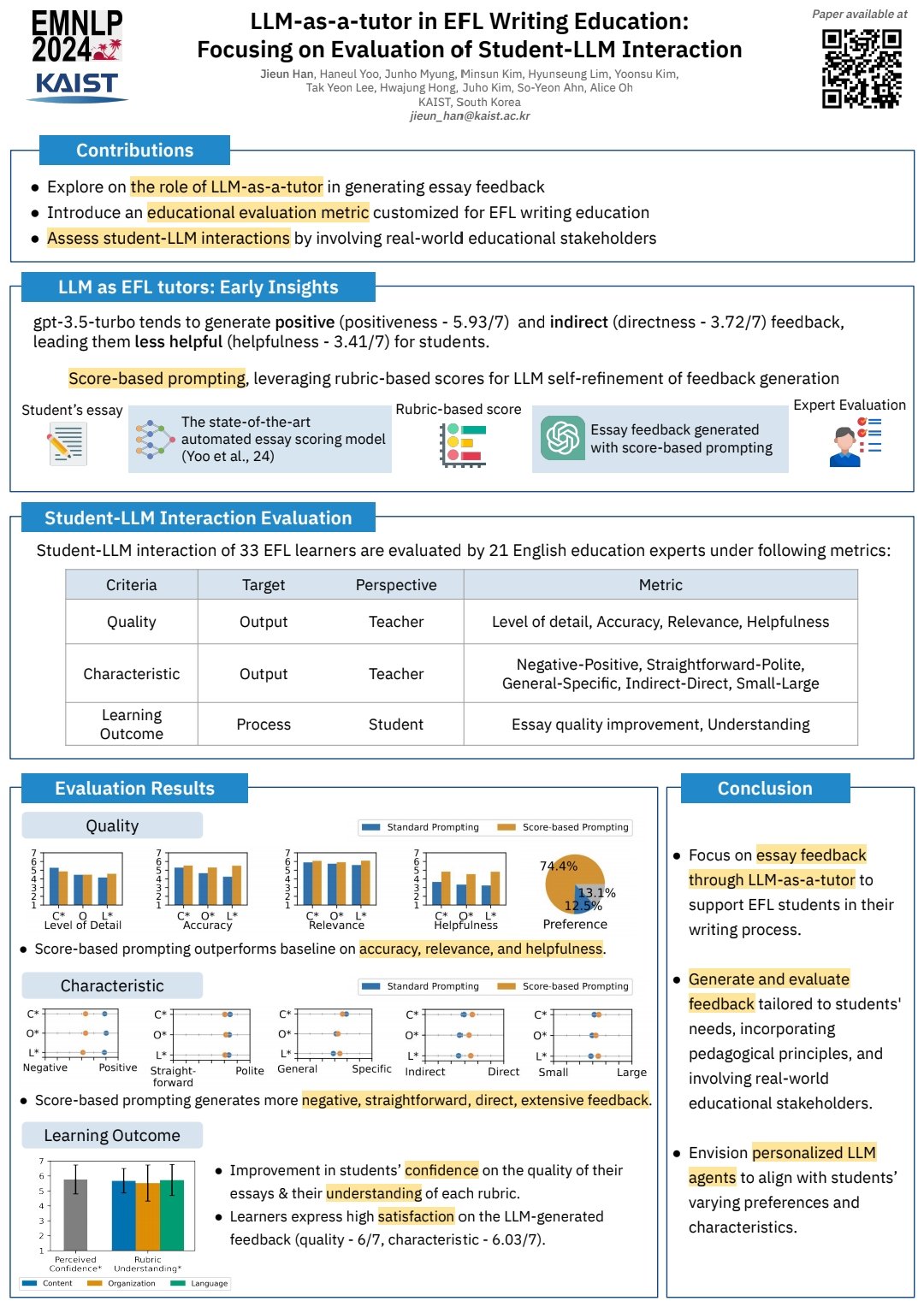 LLM-as-a-tutor in EFL Writing Education: Focusing on Evaluation of Student-LLM Interaction
EMNLP 2024 Workshop on Customizing NLP for All (CustomNLP4U)
Jieun Han, Haneul Yoo, Junho Myung, Minsun Kim, Hyunseung Lim, Yoonsu Kim, Tak Yeon Lee, Hwajung Hong, Juho Kim, So-Yeon Ahn, Alice Oh
This study addresses the challenge of assessing LLM-as-a-tutor in EFL writing education by integrating pedagogical principles, proposing three key criteria—expert evaluation (quality and characteristics of feedback) and learner assessment (learning outcomes)—to evaluate its real-time essay feedback, thereby laying the groundwork for developing effective LLM tutors tailored to the needs of EFL learners.
-
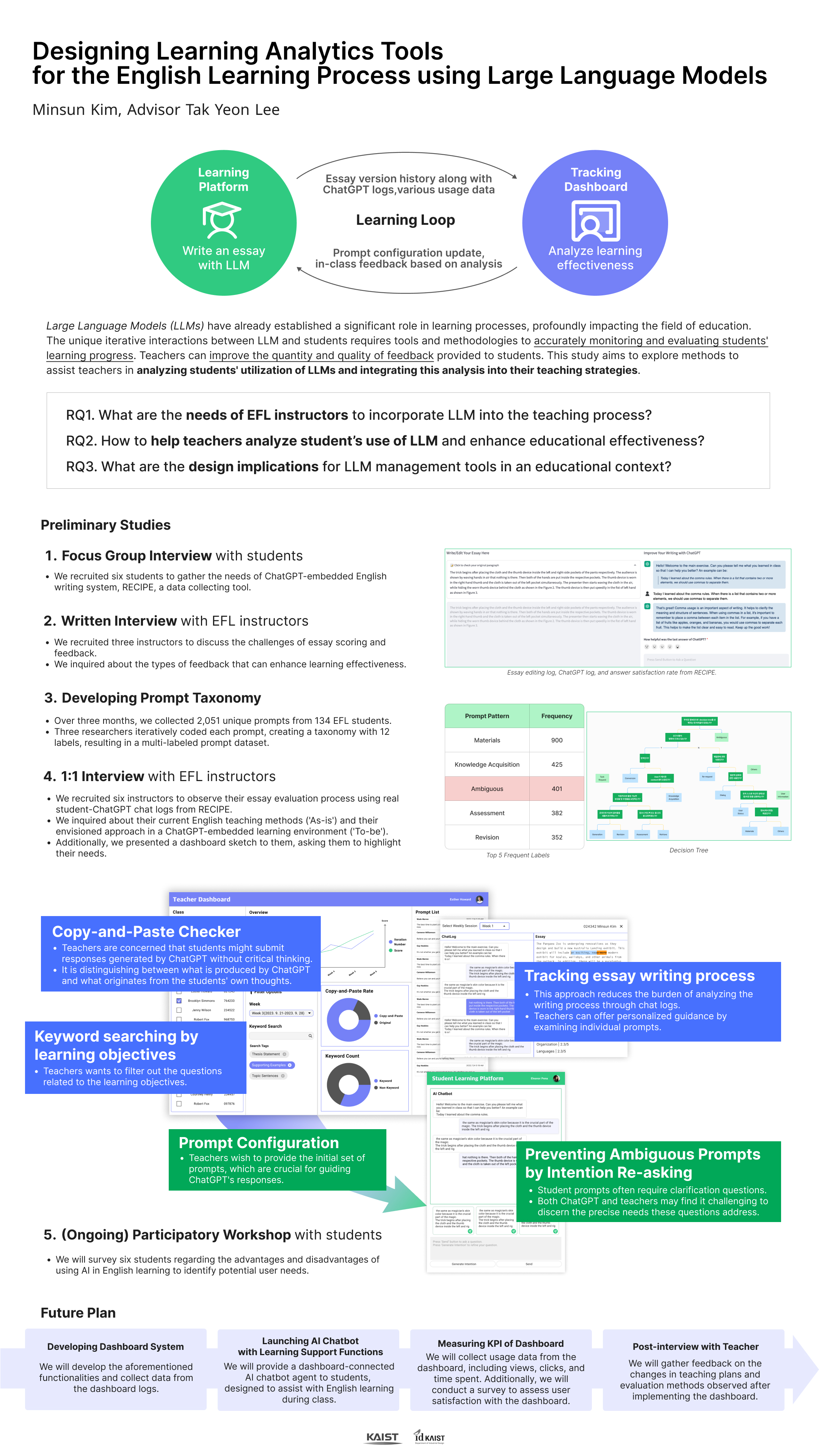 Designing Prompt Analytics Dashboards to Analyze Student-ChatGPT Interactions in EFL Writing
arXiv preprint
Minsun Kim, SeonGyeom Kim, Suyoun Lee, Yoosang Yoon, Junho Myung, Haneul Yoo, Hyungseung Lim, Jieun Han, Yoonsu Kim, So-Yeon Ahn, Juho Kim, Alice Oh, Hwajung Hong, Tak Yeon Lee
Reports on a prompt analytics dashboard prototype that supports teachers in interpreting student-ChatGPT interactions and mitigating classroom risks.
-
RRECIPE4U: Student-ChatGPT interaction dataset in EFL writing education
In Proceedings of the 2024 Joint International Conference on Computational Linguistics, Language Resources and Evaluation (LREC-COLING 2024)
Jieun Han, Haneul Yoo, Junho Myung, Minsun Kim, Tak Yeon Lee, So-Yeon Ahn, Alice Oh
Presents the RECIPE4U dataset capturing semester-long student-ChatGPT dialogues in EFL writing courses and outlines baseline analyses for educational LLM research.
2023
-
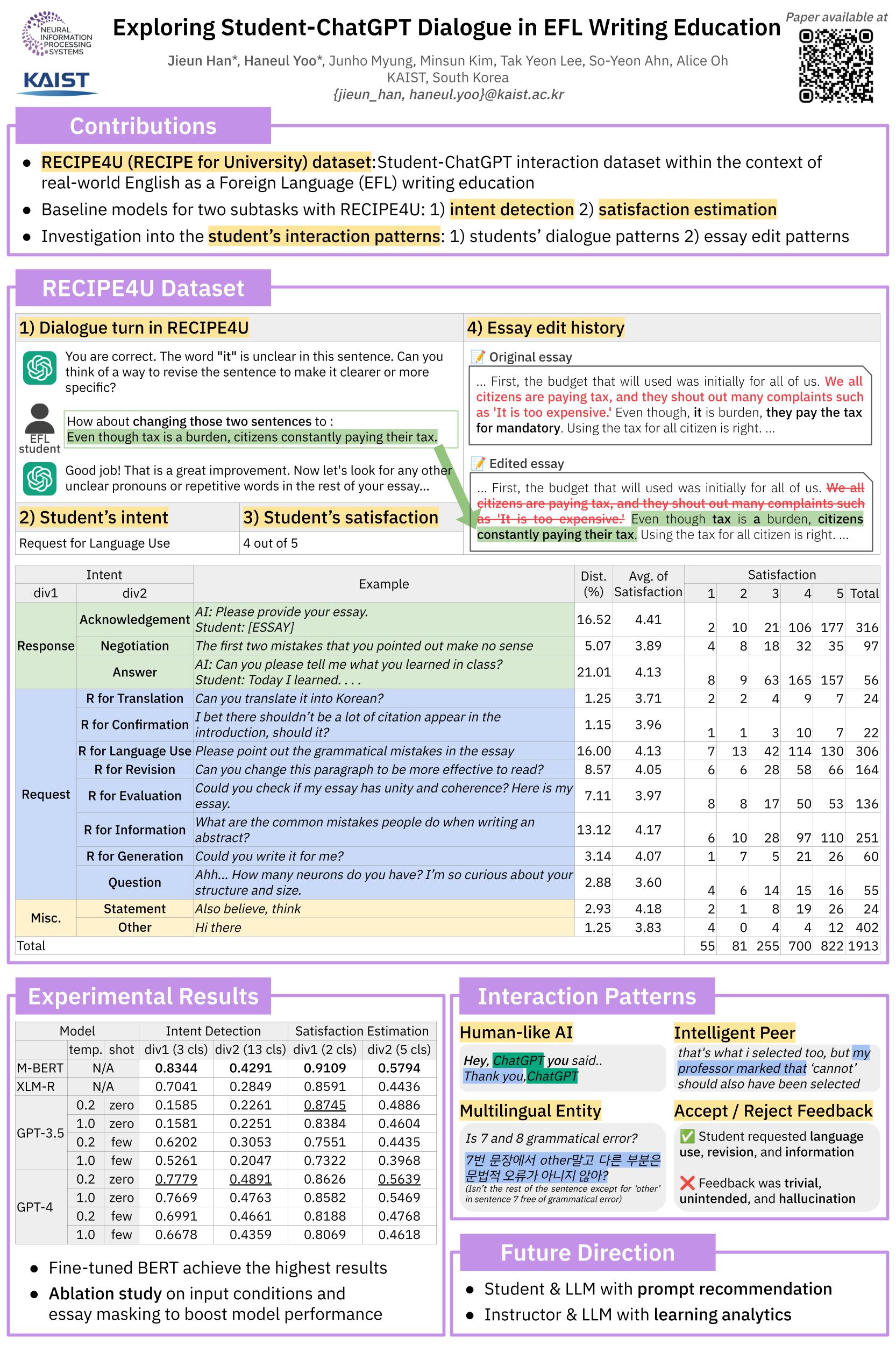 Exploring Student-ChatGPT Dialogue in EFL Writing Education
NeurIPS 2023 Workshop on Generative AI for Education (GAIED)
Jieun Han, Haneul Yoo, Junho Myung, Minsun Kim, Tak Yeon Lee, So-Yeon Ahn, Alice Oh
Presents the RECIPE4U dataset capturing semester-long student-ChatGPT dialogues in EFL writing courses and outlines baseline analyses for educational LLM research.
-
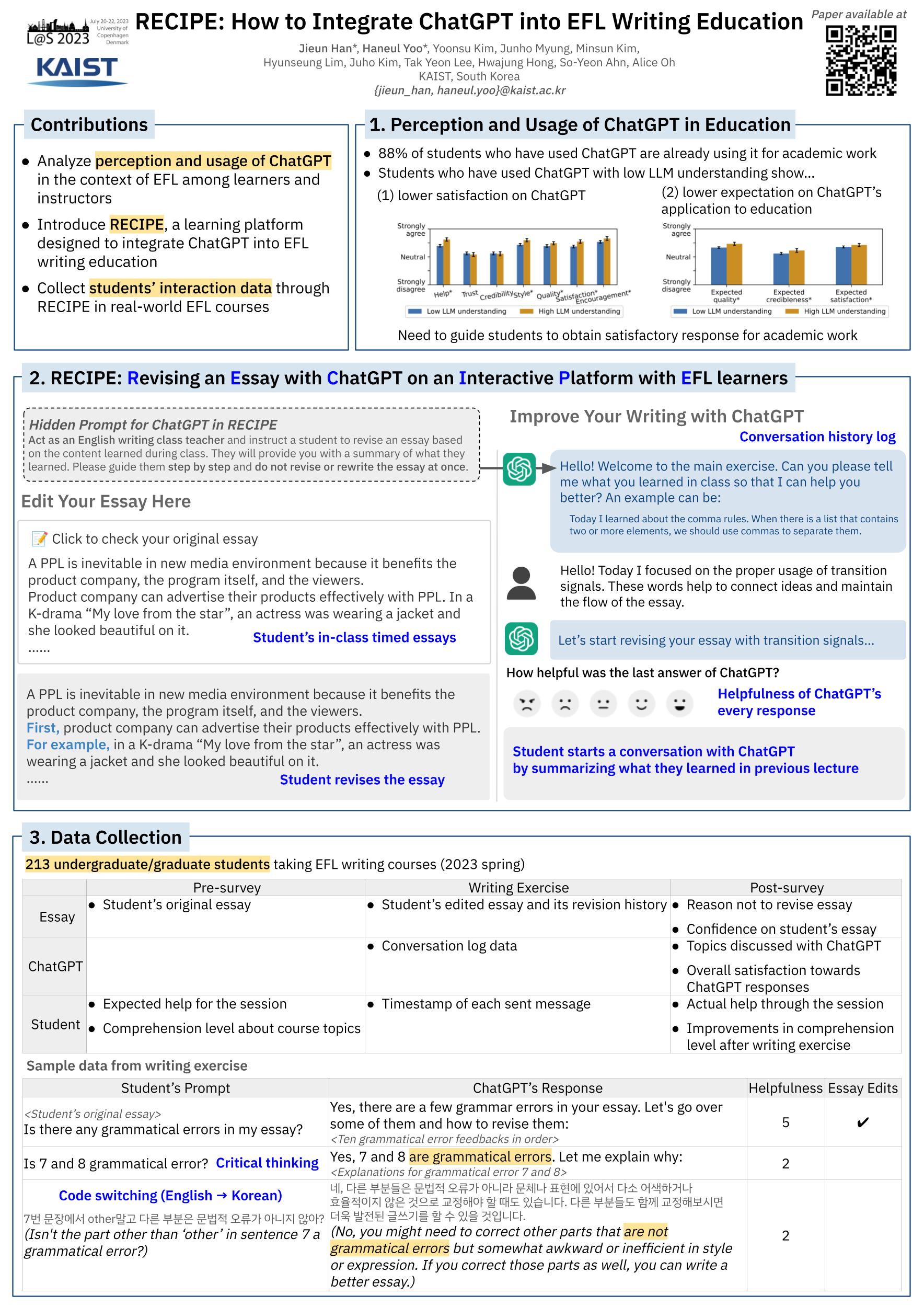 RECIPE: How to Integrate ChatGPT into EFL Writing Education
Proceedings of the Tenth ACM Conference on Learning at Scale (L@S 2023)
Jieun Han, Haneul Yoo, Yoonsu Kim, Junho Myung, Minsun Kim, Hyungseung Lim, Juho Kim, Tak Yeon Lee, Hwajung Hong, So-Yeon Ahn, Alice Oh
Describes the RECIPE platform that embeds ChatGPT into university EFL writing courses and documents deployment findings with 220+ students and instructors.